
How Long Does a Desentupidora Bertioga Job Take? A First-Timer’s Walkthrough
By the end of this article you will know what actually happens on a first call to a desentupidora Bertioga, how long each stage takes, and which mistakes cost first-timers the most time and money. You will also see the corrections that experienced property managers apply on the second call. The goal is simple: you finish reading with a realistic timeline and a short checklist you can use today.
Search intent here is mixed: some readers want to learn what the service involves, others want to compare providers, and a few are in the middle of an emergency and need to act now. The honest answer is that most residential jobs in Bertioga are resolved in one visit, usually between 40 minutes and three hours depending on access, pipe layout and how long the blockage has been building. Emergency calls at night or on weekends add travel and callout time but rarely change the technical work itself.
Bertioga has a specific profile that shapes every job: a long coastal strip, a mix of older houses near the channel and newer condominiums toward Riviera and Boracéia, plus heavy seasonal occupation. Pipes in older homes are often clay or early PVC with root intrusion, while condos deal with shared stacks and grease build-up from restaurants. A desentupidora Bertioga SP team that works this coast regularly already knows which tools suit each case.
Stage-by-stage: what a first visit really looks like
Most first-timers imagine a technician arriving with a plunger. In practice a professional visit has five stages, and each one has a predictable duration. Knowing them lets you plan the day and ask better questions on the phone.
Stage 1 — The call and triage (5 to 15 minutes)
Before anyone drives out, a good dispatcher asks three questions: where is the water backing up, is it one fixture or several, and is there a cleanout or inspection box. A single slow drain points to a local blockage; several fixtures backing up at once usually means the main line. Answering these questions precisely can cut the visit time in half, because the team arrives with the right equipment instead of guessing.
Common first-timer mistake: saying only “my sink is clogged” and hanging up. Correction: describe the symptom, the location, the property type and whether you rent or own. That single change moves the call from a vague appointment to a planned job.
Stage 2 — Travel and arrival (20 to 60 minutes)
Travel time in Bertioga depends heavily on the season and the neighbourhood. A call from the centre can be quick; a call from a condominium deep in Riviera or near the Guaratuba road takes longer, especially on summer weekends when the SP-55 backs up. Ask for an estimated arrival window rather than a precise minute, and confirm whether the technician needs gate authorisation from the condominium office.
Mistake: not warning the front desk. Correction: message the concierge with the plate number and expected time. This avoids a 15-minute delay at the gate, which is one of the most common reasons a first job runs long.
Stage 3 — Diagnosis (10 to 25 minutes)
The technician inspects the affected fixtures, opens the cleanout if one exists, and may run a camera through the line. Diagnosis is where experience shows: a camera reveals roots, collapsed sections, grease or misplaced objects, and that determines whether the fix is mechanical, hydraulic or both. If the diagnosis is skipped, the team may clear a drain that clogs again within a week.
Mistake: refusing the camera inspection to save time. Correction: accept it when the blockage is recurring or when the property is older than 20 years. Recurring clogs are a symptom, not the problem, and the camera is what separates the two.
Stage 4 — The actual clearing (15 to 90 minutes)
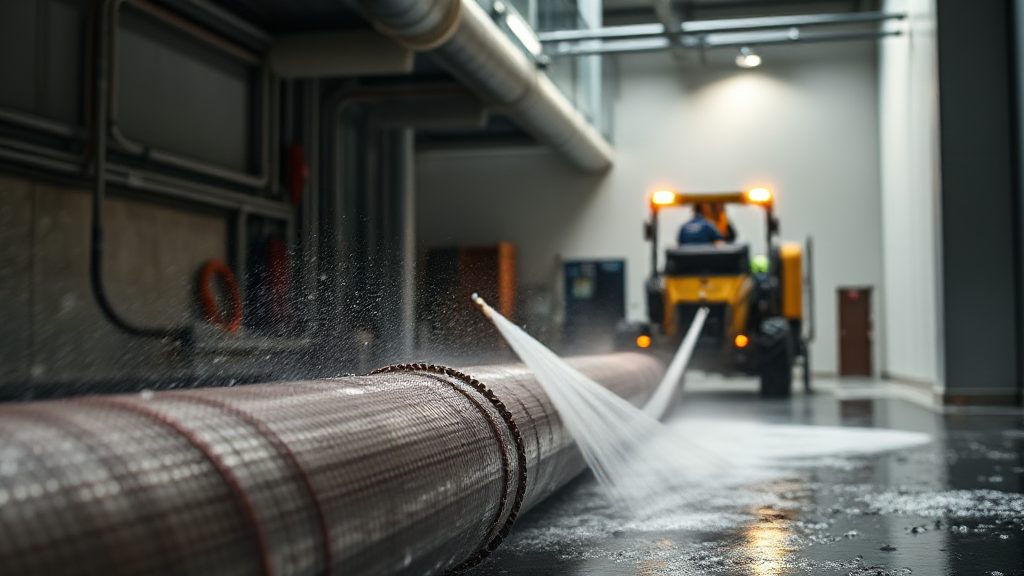
This is the core of the job and the stage that varies most. A simple kitchen drain may clear in 15 minutes with a manual cable. A main sewer line with root intrusion can take an hour or more with a rotating machine, and a heavily grease-loaded restaurant line may need hydrojetting at high pressure. Hydrojetting uses water rather than a cutting head, so it cleans the pipe wall instead of just punching a hole through the blockage.
Mistake: assuming the cheapest method is enough. Correction: ask what tool will be used and why. If the answer is “a cable” for a line that has backed up three times this year, ask whether hydrojetting would be more appropriate. A desentupidora em Bertioga SP that offers both will usually recommend the method based on the pipe material and the history of the line.
Stage 5 — Testing and handover (10 to 20 minutes)
The team runs water through every affected fixture, checks for leaks at the joints, and confirms the flow is normal before packing up. A proper handover includes a short explanation of what was found, what was removed, and what to watch for in the next weeks. This is also the moment to ask for a written record of the service, which matters if the same line fails again.
Mistake: paying and closing the door without asking questions. Correction: ask what caused the blockage and whether a preventive visit is worth scheduling. That two-minute conversation is often the difference between a one-off repair and a repeat call in three months.
Costs, trade-offs and the mistakes that cost the most
Price in this market is driven by four variables: the type of blockage, the access to the line, the time of day, and whether the job requires a truck with hydrojetting equipment. A first-timer who understands these variables negotiates better and avoids surprises.
What typically moves the price up or down
- Access: a cleanout in the yard is fast; a line buried under a finished floor is not.
- Time of day: night, weekend and holiday calls carry a callout premium.
- Method: manual cable is cheapest, rotating machine is mid-range, hydrojetting and camera inspection add cost but reduce repeat visits.
- Property type: a single house is simpler than a condominium stack shared by several units.
- Waste removal: grease, roots and debris have to be disposed of properly, and that has a cost.
A common first-timer mistake is choosing the lowest quote without asking what it includes. Correction: ask whether the price covers diagnosis, the clearing itself, testing and disposal. A quote that excludes disposal or camera inspection is not cheaper — it is incomplete. The second most common mistake is delaying the call until the backup becomes a flood; waiting turns a 40-minute job into a restoration project.
Preventive versus reactive: the real trade-off
| Approach | When it makes sense | Main downside |
|---|---|---|
| Reactive call | One-off blockage, no history of repeats | Higher emergency premium, risk of water damage |
| Preventive maintenance | Older homes, restaurants, condominiums with shared stacks | Small scheduled cost even when nothing is wrong |
For restaurants and condominiums, the preventive route usually wins because a single backup during service hours costs far more than a scheduled visit. For a single-family house with no history, reactive is reasonable. The analyst’s view is that the decision should follow the history of the line, not the price list.
Mistakes specific to first-timers in Bertioga
Three mistakes show up repeatedly on this coast. First, hiring a provider who does not serve the area and then paying travel time from another city. Second, ignoring the difference between a private line and the public network — if the blockage is in the public collector, the responsibility is not the same, and a good team will tell you so. Third, not documenting the service, which makes it hard to prove a recurring problem later.
The correction for all three is the same: ask before booking whether the company covers Bertioga, whether it can distinguish private from public responsibility, and whether it issues a written record. A provider that answers these three questions clearly is usually the one that shows up prepared.
What to do before, during and after the visit
A first-timer who prepares well gets a faster, cleaner job. The preparation is not complicated, but it is easy to forget in the stress of a backup.
Before the team arrives
- Stop using water in the affected area to avoid overflow.
- Clear access to the cleanout, the inspection box and the affected drain.
- Move furniture, rugs and stored items away from the work area.
- Confirm gate or condominium authorisation if you live in a closed community.
- Write down when the problem started and what you noticed first.
That last item is more useful than it sounds. A technician who knows the problem began after a specific event — heavy rain, a new tenant, a renovation — can narrow the diagnosis quickly.
During the visit
Stay available for questions but keep children and pets away from the work area. Ask what tool is being used and what was found. If the technician recommends a camera inspection or hydrojetting, ask for the reason in plain language. You are allowed to ask why before you say yes, and a professional team will explain without pressure.
After the visit
Run water in every affected fixture yourself to confirm the flow. Keep the service record, the date and the method used. If the same line backs up again within a few weeks, that record is what justifies a return visit under warranty or a deeper inspection. For properties with a septic tank, ask whether the tank level was checked, because a full tank can mimic a blocked line.
One final habit separates a smooth first experience from a difficult one: save the contact of the provider you used, along with the date and the method. When a problem returns, you are no longer a first-timer — you have a history, and history is what makes the second visit faster and cheaper.
Frequently asked questions about desentupidora Bertioga
How quickly can a team arrive in Bertioga?
Arrival depends on the neighbourhood and the season. Central areas are usually faster; condominiums toward Riviera and Boracéia take longer, especially on summer weekends. Ask for an arrival window when you call and confirm gate access in advance to avoid delays.
Does a first visit always solve the problem?
Most residential blockages are resolved in one visit. Recurring clogs, root intrusion or collapsed sections may need a camera inspection and a second, planned intervention. If the line has backed up more than twice in a year, ask for the inspection on the first visit.
Is hydrojetting always better than a cable?
No. A cable is faster and cheaper for a simple local blockage. Hydrojetting cleans the pipe wall and is better for grease, roots and recurring problems. The right choice depends on the pipe material and the history of the line, not on a general rule.
What should I have ready before the technician arrives?
Clear access to the cleanout and affected drains, a short description of when the problem started, and gate authorisation if you live in a condominium. These three items save the most time on a first visit.